The short version
| Package | What you get | OKC range |
|---|---|---|
| Basic | Graded pad, post-tensioned slab, acrylic surface, lines, net | $20,000–$32,000 |
| Fenced | Basic plus 10-foot ends and 4-foot sides in vinyl-coated chain link | $27,000–$42,000 |
| Complete | Fenced plus four-pole LED lighting | $33,000–$55,000 |
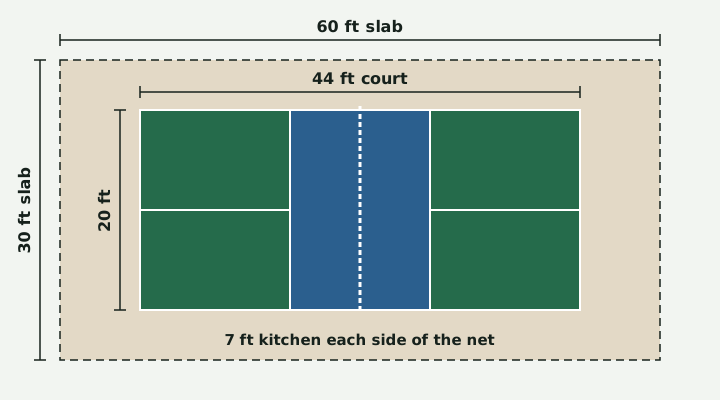
These are planning figures for a 30 by 60 foot court on a lot with reasonable truck access. They are not quotes. A quote needs someone standing in your yard.
Line by line
| Item | Range | What moves it |
|---|---|---|
| Site prep and grading | $2,000–$6,000 | Slope, tree removal, how much clay has to be hauled off |
| Rock base and post-tensioned slab | $14,000–$22,000 | Concrete prices, pump truck if the mixer cannot reach |
| Acrylic surface and lines | $3,500–$5,500 | Cushion layers, two-tone color |
| Net posts, sleeves and net | $600–$1,500 | Post quality |
| Fencing | $6,000–$10,000 | Height, how much of the perimeter, gates |
| LED lighting | $5,000–$12,000 | Distance from the electrical panel, pole count |
Why the slab is the big number
On sandy ground you could get away with a conventional rebar slab and save a few thousand dollars. On the red clay under most of Oklahoma City, Yukon and Moore, that savings buys you cracks. The post-tensioned slab described on our pickleball court construction page costs roughly $8 to $12 per square foot installed, and it is the one line we would not cut.
If a bid comes in under $12,000 for the concrete on a full-size court, ask what is in it. Four inches with wire mesh is a driveway.
What pushes a court past $55,000
- Retaining walls. More than about three feet of fall across the pad.
- Access. Older lots in Nichols Hills and Crown Heights often have no way to get a mixer to the back. Pumping concrete over the house adds $1,500 to $3,000.
- Long electrical runs. Trenching 150 feet from the panel for lights.
- Cushioned surfaces. Rubberized layers under the color are easier on knees and add $3,000 to $6,000.
Where to save without regretting it
Fence only the two ends now and run conduit for lights before the pour. Both can be finished later without tearing anything up. A plain single-color surface costs less than two-tone and plays the same. And if you already own a sound slab, installing a court on existing concrete starts around $4,000.
Ongoing costs
Close to nothing for the first five years. Blow the leaves off, hose it down. Budget $2,500 to $6,000 for resurfacing every five to eight years. LED lights for one court cost a few dollars a month to run.
How people pay for a court
We are not lenders and this is not financial advice. For what it is worth, homeowners usually pay one of three ways: cash, a home equity line of credit, or an unsecured home improvement loan from a bank or credit union. Some builders also work with a lender and can offer monthly payments. Ask when you get your estimate. Expect a deposit at signing, a draw when concrete is poured and the balance when lines are down.
Questions homeowners ask
Why do online estimates say a pickleball court costs $15,000?
Those figures usually assume a conventional slab on stable soil with no fence or lights. On Oklahoma City clay, with a post-tensioned slab, $20,000 is a realistic floor for a full-size court.
Does a pickleball court raise my property taxes?
It can. A court is an improvement, and county assessors may add value for improvements. How much, if anything, varies. Your county assessor's office can tell you how they treat sport courts.
Is a pickleball court cheaper than a pool?
Usually by half or more. An in-ground pool in the OKC metro commonly runs $60,000 and up, with chemicals, power and a cover every year after. A court has almost no upkeep.
Can I build in phases?
Yes. Slab, surface and net first. Fence and lights later. Have the conduit and footings planned from day one so nothing gets cut.