What a city may want to review
A backyard court is really four projects: a slab, a fence, lights and a change to how your lot drains. Each can trigger its own review.
| Part | What usually applies |
|---|---|
| Concrete slab | Rules vary. Some cities do not permit flatwork at grade; others count it toward lot coverage or impervious area limits. |
| Fence | Often permitted, and 10 feet is above normal residential height limits in most places. May need a variance or a specific exception for sport enclosures. |
| Lighting | Electrical permit, pulled by a licensed electrical contractor, with inspection. |
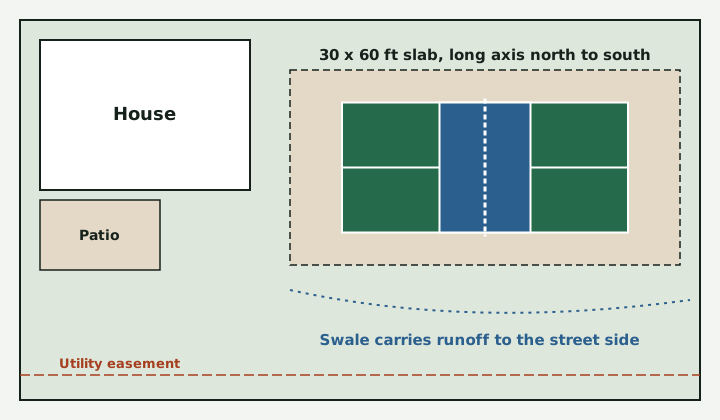
| Drainage and easements | No permanent structures in utility or drainage easements. Runoff cannot be redirected onto a neighbor. |
We do not publish exact numbers here because they change and because a wrong number is worse than none. Before quoting, the builder confirms current rules with the right office for your address.
Who to call, by city
- Oklahoma City. Development Services handles building, fence and electrical permits and zoning questions.
- Edmond, Norman, Moore, Yukon, Mustang. Each has its own building or community development department and its own fence and accessory-structure rules.
- Nichols Hills and The Village. Separate cities with their own codes, even though they are surrounded by Oklahoma City. Nichols Hills in particular reviews exterior projects closely.
- Unincorporated county land. Fewer rules, but check for floodplain and any recorded covenants.
Your mailing address can mislead you. Plenty of homes with an Edmond address are inside Oklahoma City limits, especially in the Deer Creek school district. The county assessor's website shows which city you are actually in.
Historic districts
Heritage Hills, Mesta Park, Crown Heights and several other central Oklahoma City neighborhoods are historic preservation districts. Visible exterior changes there can need a certificate of appropriateness before any permit is issued. Lots are also small. Full courts in these neighborhoods are rare.
HOA approval
If you live in a neighborhood with covenants, the architectural review committee is usually a bigger hurdle than the city. Read the covenants first. Some ban sport courts outright. More often they are silent, which means you are asking for a judgment call.
A submission that tends to get approved includes:
- A site plan to scale showing the court, distances to each property line and the easements.
- Fence height, material and color. Black vinyl-coated chain link is the easiest to get through.
- Light pole height, fixture cut sheets showing shielding, and a shutoff time you commit to.
- A drainage note showing where runoff goes.
- A landscaping plan to screen the court from the street or the nearest neighbor.
Talk to the neighbors who share a fence line before the committee meets. The objection is nearly always noise. Offering set hours and placing the court on the far side of the yard does more than any drawing.
Timeline
Allow two to six weeks for HOA review, since many committees meet monthly. City permits for fence and electrical are usually faster. None of this delays design: the paperwork runs while the estimate and layout are being finished. Once approvals are in hand, building follows the steps on the pickleball court construction page.
Before any digging
Oklahoma law requires a utility locate before excavation. A request through OKIE811 is free and marks public utilities within a few business days. Private lines such as sprinklers, pool plumbing and gas to a grill are not covered and need to be found separately.
Questions homeowners ask
Can my HOA stop me from building a pickleball court?
If the recorded covenants prohibit sport courts or require architectural approval, yes. Read them before spending money on design.
Do I need a permit for a concrete slab in Oklahoma City?
Flatwork rules depend on the project and location. The fence and any electrical work are the parts most likely to need permits. Confirm with Development Services for your address.
How close to the property line can a court be?
It depends on your city's setbacks, your plat's easements and your HOA. Many lots end up with the court 10 feet or more off the rear line once the easement is respected.
Who pulls the permits?
The contractor doing the work typically pulls fence and electrical permits. The homeowner signs the HOA application.