How much light a court needs
Light on a court is measured in footcandles at the surface. For backyard play, an average of 30 is comfortable. Club courts aim for 50. Just as important is evenness: bright in the middle and dim at the baselines is worse than a slightly dimmer court lit evenly, because the ball seems to change speed as it crosses the boundary.
A standard backyard layout
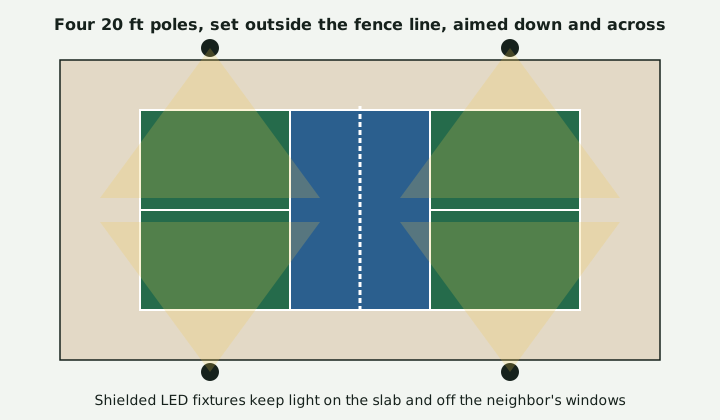
- Poles. Four, at 18 to 22 feet tall. Two per side, roughly in line with the kitchen lines.
- Fixtures. One LED sport light per pole, 150 to 300 watts each, with shields that cut off light above horizontal.
- Color. 4000K to 5000K. Whiter light makes a yellow ball easier to track.
- Controls. A switch at the gate and a timer that shuts everything off at a set hour.
Budget courts use two taller poles at the net line. It works, with more shadow at the baselines.
Wind is the engineering problem
A 20-foot pole with a fixture on top is a lever, and Oklahoma City gets straight-line winds over 70 mph in a bad spring. Poles are set on poured concrete bases, typically 18 to 24 inches across and 4 to 5 feet deep, sized for the pole height and the soil. On expansive clay the base goes deep enough to anchor below the zone that moves with the seasons. A pole simply bolted to the edge of the court slab is not acceptable.
Electrical
Lighting is wired on a dedicated circuit, with conduit trenched from the house panel to the court. In Oklahoma, that work is done by a licensed electrical contractor under an electrical permit, and it gets inspected. If your panel is full or the run is long, that is where cost climbs.
One piece of advice even if lights are not in this year's budget: put the conduit and pole bases in during construction. Sleeves under or beside a slab cost very little before the pour and a great deal after. This fits into step three of the sequence on our pickleball court construction page.
Neighbors, HOAs and glare
Most complaints about court lights are about glare and spill, not brightness. Three things prevent them: full-cutoff shields, poles no taller than they need to be, and aiming fixtures across the court instead of outward. Many HOA design guidelines in Edmond and northwest Oklahoma City cap pole height or require a shutoff time. Get the rule in writing before ordering poles. More on that under permits and HOA approval.
Cost
| Setup | OKC range |
|---|---|
| Two-pole basic | $5,000–$7,500 |
| Four-pole standard | $8,000–$12,000 |
| Conduit and bases only, for lights later | $1,200–$2,500 |
Running cost is small. Four 200-watt fixtures used three hours a night draw about 2.4 kilowatt-hours, well under a dollar.
Questions homeowners ask
Can I light a pickleball court with floodlights on the house?
You can see the ball, but the light comes from one side and low, so half the court plays into glare. Purpose-built poles on both sides are a big step up.
Are solar court lights good enough?
Not yet for real play. Solar fixtures that reach 30 footcandles across a court need large panels and batteries and cost more than wiring from the house.
Do court lights need a permit in Oklahoma City?
The electrical work does, and it must be done by a licensed electrician. Some cities and HOAs also regulate pole height.