The ground under the metro
Central Oklahoma's red color comes from iron in the Permian shale and mudstone the soil formed from. Across most of Oklahoma City, Yukon, Mustang, Moore and west Norman, that parent rock weathers into clay with a high shrink-swell potential. Soil surveys label much of it Renfrow, Kirkland or Bethany. Builders call it gumbo.
When it rains in May, the clay takes on water and expands. By late August, after six weeks without real rain, it has dried, shrunk and cracked open an inch wide. The top several feet of soil cycle like this every year. The surface can rise and fall more than an inch.
Drive east and it changes. Past I-35, in east Edmond, Arcadia, Choctaw and toward Lake Thunderbird, the Cross Timbers begin: sandy loam over sandstone, blackjack and post oak instead of prairie. That soil drains quickly and barely moves. A court there needs less soil treatment and sometimes more rock excavation.
Step one: get the soil to the right moisture, then keep it there
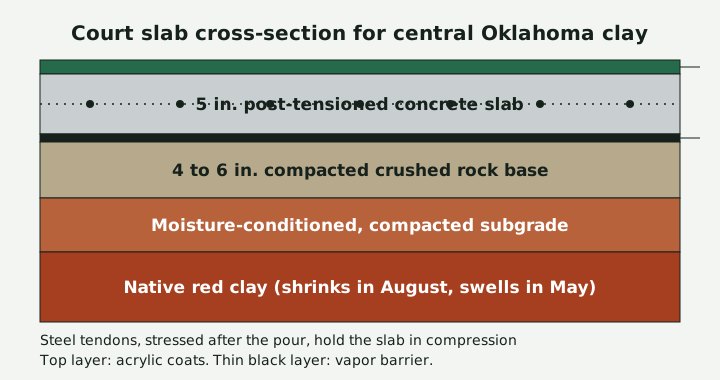
Clay compacted bone dry will swell the first time it gets wet under your slab. Clay placed too wet will shrink. So the subgrade is watered or dried to slightly above its optimum moisture and compacted in thin lifts. Then it is covered quickly, before the sun changes it.
On sites with very active clay, the top foot or two may be replaced with select fill that does not swell, or treated with lime. A geotechnical engineer makes that call on large or costly projects.
Step two: a rock base
Four to six inches of crushed aggregate, compacted. It spreads load, gives a uniform bed for the concrete and breaks the capillary path that would otherwise wick moisture up into the slab.
Step three: a slab that moves as one piece
Movement cannot be stopped completely. It can be made harmless. A post-tensioned slab is held in compression by steel tendons, so it floats on the soil like a raft. Edges may rise and fall a fraction of an inch over a year. The surface stays in plane. The pour itself is described on our pickleball court construction page.
Step four: move water away, on purpose
- Slope the slab. One inch in 10 feet, in a single plane, side to side where possible. Never crowned in the middle and never sloped toward the net.
- Grade the surrounding yard so water leaving the court keeps going. A slab is 1,800 square feet of new runoff. In a one-inch storm that is over 1,100 gallons.
- Cut a swale on the uphill side so the neighbor's runoff goes around the court, not under it.
- Do not send it next door. Runoff has to reach the street, a drainage easement or your own lawn. Pushing concentrated water onto an adjoining lot invites a dispute with the neighbor and the city.
The mistake that shows up in year three
Uneven moisture. One side of the court next to irrigated lawn, the other beside a dry fence line. Or a big tree at one corner drinking the clay dry every summer. The wet side swells, the dry side shrinks and the slab tilts. Even watering around the whole perimeter, sprinkler heads that do not soak one edge, and distance from large trees all matter as much as what is under the concrete.
Questions homeowners ask
Why do concrete slabs crack so much in Oklahoma City?
Because the clay under them swells when wet and shrinks when dry, by more than an inch in a year. A thin slab without enough reinforcement cannot bridge that movement.
Is a soil test necessary for a backyard court?
Not always for a single residential court, but it is cheap insurance on lots with visible foundation or driveway problems, and standard for multi-court projects.
Will the court flood my yard?
Not if it is graded correctly. The slab sheds water to one side, and the yard beside it is shaped to carry that water to the street or a drainage easement.
How flat is a court if it is sloped for drainage?
A 1 percent slope is 3 to 3.6 inches of fall across a 30-foot width. You cannot see it or feel it in play.