What a tennis court costs here
| Package | What you get | OKC range |
|---|---|---|
| Basic | Graded pad, post-tensioned slab, acrylic surface, lines, net | $70,000–$115,000 |
| Fenced | Basic plus 10-foot vinyl-coated chain link on all four sides | $85,000–$135,000 |
| Complete | Fenced plus LED lighting | $100,000–$165,000 |
Planning figures for one full-size court on a site trucks can reach. A quote needs a site visit, and on a project this size it should follow a soil report.
Line by line
| Item | Range | What moves it |
|---|---|---|
| Site prep and grading | $5,000–$15,000 | Slope across 120 feet, tree clearing, select fill |
| Rock base and post-tensioned slab | $58,000–$86,000 | Concrete prices, pumping, tendon design |
| Acrylic surface and lines | $8,000–$13,000 | Cushion layers, color count |
| Net posts, footings, net, center anchor | $1,000–$2,500 | Post quality |
| Fencing, about 360 linear feet | $12,500–$20,000 | Height, gates, windscreen-rated posts |
| LED lighting | $15,000–$30,000 | Pole count, distance to the panel |
The slab is two-thirds of the basic price. That is simple arithmetic: 7,200 square feet at $8 to $12 a foot.
Does your property fit one?
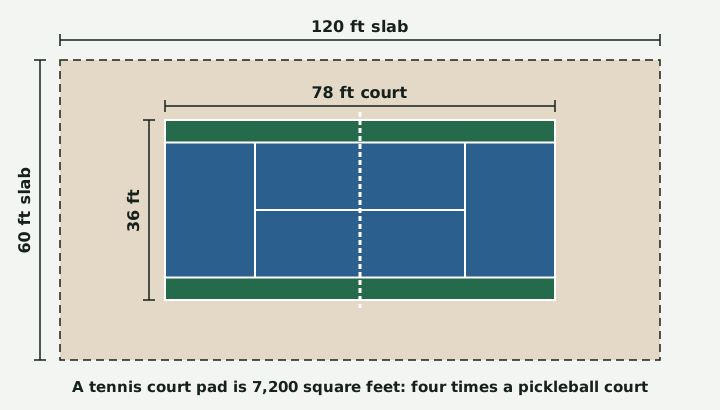
The pad is 60 by 120 feet, and it wants to run north to south. Add room for a fence, a way to walk around it and whatever your city or HOA requires for setbacks, and you need a clear, nearly level area of roughly 70 by 130 feet.
In practice that means an acre or more. The lots that work are the acreages north of Edmond and around Deer Creek, east toward Arcadia and Choctaw, south of Norman, and a handful of the deepest lots in Nichols Hills. On a half-acre subdivision lot, a tennis court almost never clears the easements. If that is your situation, a pickleball or multi-sport pad uses a quarter of the space. Start with pickleball court construction.
Why the slab is harder at this size
Expansive clay does not get wet evenly. One end of a 120-foot pad may sit beside irrigated lawn while the other bakes next to a gravel drive. The soil under the two ends swells and shrinks on different schedules, and the slab between them has to take it.
So a tennis court here is built as one post-tensioned slab, 5 inches thick, with tendons running both directions and no sawn joints. The subgrade is brought to a uniform moisture and compacted before a rock base goes down. On very active clay an engineer may call for a foot or two of non-swelling fill first. A geotechnical report costs $1,500 to $3,000 and is worth it on a six-figure pour. The reasoning is laid out on the drainage and base prep page.
What about asphalt?
Asphalt tennis courts cost roughly 30 to 40 percent less to build, which is why so many 1980s neighborhood courts used it. It also softens in August heat, dries out and shrinks with age, and cracks along its paving seams. On this soil most asphalt courts need major crack repair within ten years. We recommend concrete and will tell you so even when it costs us the cheaper sale.
Drainage on a pad this large
The court falls 1 inch in 10 feet in a single plane, side to side when the site allows. That is 6 inches across the 60-foot width. In a one-inch rain the pad sheds about 4,500 gallons, all of it off one edge. The yard on that side needs a swale or a drain sized for it, and the water has to end up somewhere it is allowed to go.
Surface choices
Standard acrylic hard court is what nearly everyone builds. A cushioned system adds $10,000 to $20,000 on a court this size and is easier on joints. Clay and grass courts are a different undertaking in this climate: both need daily attention and a great deal of water, and we would talk most homeowners out of them. Color and texture options are on the surfacing and color page.
Fence, wind and lights
A tennis court is fenced on all four sides at 10 feet. If you want windscreen, and with an Oklahoma south wind you will, the posts and footings are sized for it from the start. See court fencing.
Lighting a tennis court properly takes six to eight fixtures on poles 20 to 25 feet tall. That is more light and more height than a pickleball court, so it draws more attention from HOAs and neighbors. Details are under court lighting.
Timeline
Plan on 10 to 14 weeks from the first day of dirt work, including the 28-day cure. Design, soil testing, HOA review and permits come before that and commonly take one to two months. Surfacing needs 50 degrees and rising, so the practical window to finish a court here runs April through October.
One slab, two sports
Many new tennis courts are striped for pickleball from day one. Blended lines for two or four pickleball courts add $500 to $1,500 while the surfacing crew is already there. If the pickleball crowd takes over later, the pad is ready for a full tennis to pickleball conversion.
Already have a court?
If the slab is sound and the problem is faded color and cracks, tennis court resurfacing runs $6,000 to $12,000. A new pad is for properties with no court, or with one that has heaved past saving.
Questions homeowners ask
How much does it cost to build a tennis court in Oklahoma City?
Roughly $70,000 to $115,000 for a post-tensioned slab, acrylic surface and net. With full fencing and lighting, $100,000 to $165,000.
How much land do I need for a tennis court?
A clear, nearly level area of about 70 by 130 feet after setbacks and easements. Most properties that fit one are an acre or larger.
Is concrete or asphalt better for a tennis court in Oklahoma?
Post-tensioned concrete. Asphalt is cheaper to build but cracks on expansive clay and softens in summer heat, so it costs more to keep playable.
Can a new tennis court also have pickleball lines?
Yes. Blended pickleball lines in a contrasting color cost $500 to $1,500 when added during surfacing.