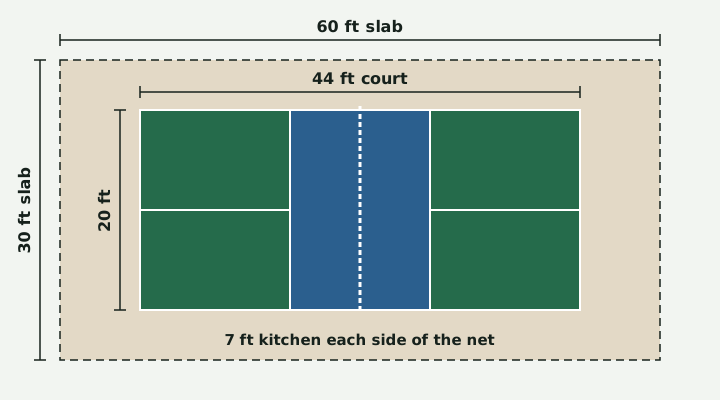
The numbers
| Measurement | Size |
|---|---|
| Playing lines | 20 x 44 ft |
| Non-volley zone (the kitchen) | 7 ft each side of the net |
| Net height | 36 in. at posts, 34 in. at center |
| Minimum slab | 30 x 60 ft |
| Preferred slab | 34 x 64 ft |
| Line width | 2 in. |
| Overhead clearance | 18 to 20 ft |
The extra slab around the lines is not a luxury. A good lob lands at the baseline and the player chasing it needs somewhere to stop that is not a fence post. At 30 by 60 you have 8 feet behind each baseline and 5 feet on each side. At 34 by 64 you have 10 and 7.
Will it fit your lot?
Start with your plat or the survey from closing. You are looking for three things.
Easements. Most subdivision lots in the metro carry a utility easement along the rear line and sometimes a side. Widths vary by plat. You generally cannot put a permanent slab in one.
Setbacks. Cities and HOAs set how close a structure can sit to the property line. Whether a slab at grade counts as a structure differs between Oklahoma City, Edmond and Norman, and the fence around it almost always does.
What is left. Take the yard, subtract easements and setbacks, and see whether a 30 by 60 rectangle fits with its long side running roughly north to south.
As a rough guide: a typical quarter-acre lot in a 1990s or newer subdivision can fit a court only if the house sits forward and the backyard is wide. Half-acre lots usually work. Acreages in Deer Creek, Arcadia and east Norman have room for anything.
Slope
The finished court falls 1 inch per 10 feet in one direction. The yard it sits in can be steeper, but every foot of fall across the pad is dirt to cut on one side and fill on the other. Up to about two feet across 60 feet is routine. Beyond three, plan for a retaining wall.
Access for equipment
A skid steer needs a gate opening of about 6 feet. A concrete truck needs to get within 15 feet or so of the forms, or the concrete has to be pumped. Older parts of town with narrow side yards and mature trees, like Crown Heights and Nichols Hills, are where access drives cost.
Trees and utilities
Keep the slab outside the drip line of large trees if you can. Roots lift concrete, and a big pecan or oak pulls enough water out of clay in August to shrink the soil on one side of the pad. Before any digging, a free OKIE811 locate marks buried gas, electric and communication lines. Sprinkler lines are on you. Expect a few to be rerouted.
Basketball and multi-sport sizes
A basketball half court runs 30 by 30 up to 30 by 50. If you want pickleball and basketball on one pad, 30 by 60 is the minimum and 34 by 64 is better. Once you know the size, the pickleball court construction page walks through how the pad gets built.
Questions homeowners ask
What is the smallest yard that fits a pickleball court?
You need a clear, buildable rectangle of 30 by 60 feet after easements and setbacks. Some players accept 26 by 54 for casual play, but it feels tight.
Which direction should a pickleball court face?
Long axis north to south, so the sun is never directly behind the opposing player in morning or evening.
Can the court go right up to my fence line?
Usually not. Rear and side easements and city or HOA setbacks typically keep permanent improvements several feet off the line. Check your plat first.