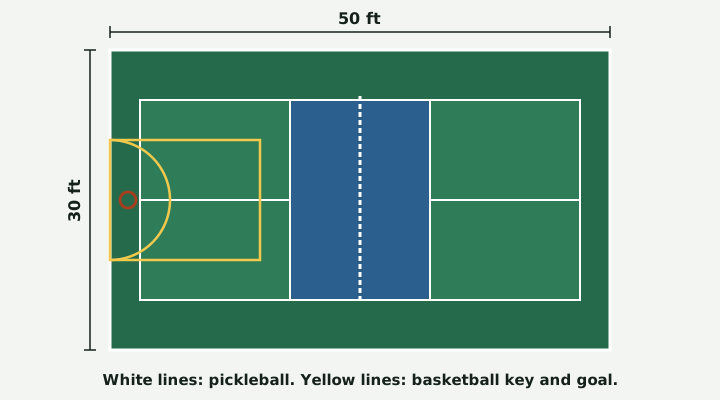
What fits on one court
A 30 by 60 foot slab holds a regulation pickleball court with room to run. Put a basketball goal at one end and you have a half court with a full three-point line. Add sleeves at the sidelines and a taller net turns it into a badminton or short-court volleyball setup. Four square and hopscotch cost almost nothing to stripe.
Go to 35 by 65 or larger and the options open up: two goals for short full-court basketball, or a pickleball court that does not share its baseline with a free throw lane.
Lines without confusion
The trick is color. The primary sport gets white lines. The second sport gets a contrasting color, usually yellow or light blue. A third gets a muted tone. After a week your eye stops seeing the lines you are not using.
Decide which sport is primary before the surface goes down. If it is pickleball, the kitchen gets its own color block and basketball lines cross it. If it is basketball, the key gets the color and pickleball lines run over the top.
Build details that change with multi-sport
- Goal placement. The basketball post sits behind the pickleball baseline, with the backboard overhanging. You need about 4 feet of slab or run-off behind that baseline, which is one reason to pour 64 feet instead of 60.
- Removable net posts. Pickleball posts lift out of flush sleeves so the middle of the court is clear for basketball.
- Surface. Acrylic with a medium sand texture is the compromise that suits both. Heavier texture grips better for pickleball but chews up basketballs.
- Fence. Ten feet behind the goal end keeps airballs out of the neighbor's yard.
Underneath, it is the same court. The grading, base and post-tensioned slab are covered step by step on the pickleball court construction page, and none of it changes because you added a hoop.
Cost
Most game courts in the metro run $30,000 to $65,000. A 30 by 60 slab with acrylic, one net, one goal and end fencing sits near the bottom of that range. A 35 by 70 with lights, full fencing and two goals sits near the top. Compare against the single-sport numbers on the pickleball court cost page: the second sport typically adds $3,000 to $6,000.
Where these make the most sense
Acreages. The one-acre and larger lots north of Edmond around Deer Creek, east toward Arcadia and south of Norman have room to set a 35 by 70 pad well back from the house and the property line. On a standard subdivision lot, a 30 by 60 slab is usually the ceiling once setbacks and easements come off the plat.
Questions homeowners ask
Can one court really work for both pickleball and basketball?
Yes. The only real compromise is surface texture, and a medium grit works fine for both. Removable net posts keep the middle clear.
What is the best size for a multi-sport court?
30 by 60 feet is the minimum that gives you regulation pickleball. If you have the room, 34 by 64 or 35 by 70 keeps the basketball goal out of the pickleball run-off.
Can lines be added to my court later?
Yes. Extra game lines can be painted any time the weather is warm and dry. It takes a day.