What goes into a court that lasts
A pickleball court looks simple. Flat rectangle, some paint, a net. The part that decides whether it is still flat in ten years is underground, and it is the part cheap bids skip.
1. Layout and dirt work
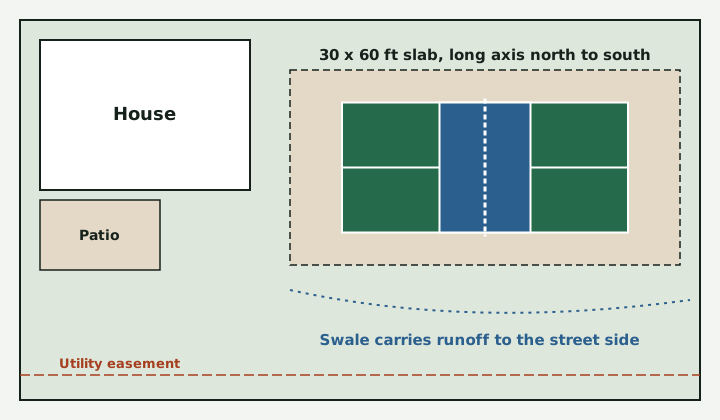
We stake a 30 by 60 foot pad (34 by 64 if the yard allows) with the long axis running north to south, so nobody serves into a low sun. In Oklahoma City that orientation also puts the prevailing south wind at one baseline instead of across the court.
Topsoil comes off. The clay underneath is brought to the right moisture and compacted in lifts. Then 4 to 6 inches of crushed rock goes down and is compacted again. The pad is graded to fall 1 inch in every 10 feet, in one plane, so water sheets off and never ponds. More on that under drainage and base prep.
2. Post-tensioned concrete
The slab is 5 inches of concrete over a vapor barrier, with steel tendons laid in a grid. A few days after the pour, each tendon is pulled tight with a hydraulic jack and locked off. The slab is now under compression. When the clay heaves in a wet spring, the pad lifts as a unit instead of breaking into plates.
There are no control joints sawn across the playing surface. That matters: every joint in a conventional slab is a future crack line telegraphing through your paint.
The finish is a medium broom, not a slick steel trowel. Acrylic needs texture to grip.
3. The 28-day wait
Fresh concrete is full of water and alkalinity. Coat it early and the acrylic blisters within a year. So the slab cures for 28 days. This is when net post sleeves, fence posts and light pole bases get set.
4. Surface, lines and net
The slab is acid-washed and primed. Then an acrylic resurfacer, two color coats with silica sand for grip, and 2-inch white lines. See surfacing and color options for what the sand does and which colors run cooler in July.
Net posts drop into the sleeves so they can come out if you ever want the pad for a party.
5. Fence and lights
Optional, but most people who skip the fence regret it by the second weekend. Our pages on court fencing and court lighting cover heights, pole placement and what neighbors and HOAs tend to push back on.
Timeline in the OKC building season
| Stage | Time |
|---|---|
| Site walk, estimate, HOA and permit paperwork | 2 to 6 weeks |
| Grading, base, forms | 3 to 5 days |
| Pour and tendon stressing | 1 week |
| Cure | 28 days |
| Surfacing, lines, net, fence, lights | 1 to 2 weeks |
Concrete can be poured most of the year here. Coating cannot. Acrylic needs 50 degrees and rising and a dry slab, so a court poured in November usually gets its color in March or April. Spring rain adds delays: a week of storms in May means a week of waiting for the subgrade to dry.
What it costs
A slab, surface and net runs $20,000 to $32,000 on a reasonably flat lot. Add a fence and you are at $27,000 to $42,000. With lights, $33,000 to $55,000. The line-by-line version is on the pickleball court cost page.
Questions homeowners ask
Can you build a pickleball court on a sloped yard?
Yes, within reason. A foot or two of fall across 60 feet is handled with cut and fill. Past about three feet you are looking at a retaining wall on the low side, which can add $5,000 to $15,000.
Is asphalt cheaper than concrete for a court in Oklahoma?
Asphalt costs less on day one, but it softens in 100-degree heat, cracks as the clay moves and needs resurfacing sooner. For a single backyard court, post-tensioned concrete is the better money.
Do I need a permit to build a pickleball court in Oklahoma City?
It depends on what is in the project. Fences and electrical work for lights are permitted through the city, and each suburb has its own rules. We sort that out before digging. See our page on permits and HOA approval.
Will the court crack?
Any concrete can develop hairline cracks. The point of post-tensioning is that the cracks stay closed and the slab stays in one plane, so you do not get the offset edges that ruin a bounce.